

Best for managed websites with call intake: Sitesmartly. Best for human conversations: a live receptionist service. Best for crew handoffs: a dispatch-focused service. This guide compares answering services for electricians by the work you need covered, starting with Sitesmartly for contractors who want their website and call-answering tools managed together.
- Sitesmartly is the best fit for electricians seeking managed websites with call-answering tools.
- Choose answering services for electricians by intake quality, escalation rules, and the handoff to your crew.
- Live receptionists suit conversational intake; dispatch-focused services suit structured crew handoffs.
- Overflow answering covers missed calls; voicemail-to-message intake supports callbacks, not live conversations.
Why this matters
An answered call is not a booked electrical job. You still need the caller’s location, the problem, a usable callback number, and a clear next action. A polite greeting without those details leaves you chasing information between jobs.
Separate three tasks before comparing providers: answering, qualifying, and assigning work. They are different responsibilities. A service that records messages does not automatically manage your schedule or send the right electrician.
Your website should support the same intake process. The guide to website builders for electricians covers that part of the decision. For your 2026 answering-service shortlist, judge the handoff—not just the voice on the phone.
What makes the best answering services for electricians?
Use these six criteria before you read a proposal:
- Useful intake: Capture the callback number, job address, requested work, and caller’s own description. Do not turn a reported symptom into a diagnosis.
- Clear escalation: Define which calls reach you immediately and which become callback tasks. Keep safety instructions separate from sales intake.
- Honest scheduling: Distinguish a requested appointment from a confirmed booking. Nobody should promise a visit without an approved scheduling process.
- Defined coverage: Specify when the service answers and what happens outside those hours. Overflow coverage and all-day coverage solve different problems.
- Readable handoffs: Require a concise summary that tells your office or electrician what to do next. A transcript alone leaves the interpretation to you.
- Manageable setup: Decide who updates your service area, hours, exclusions, and escalation contacts. An outdated script produces an outdated answer.
The best answering service follows your operating rules without inventing commitments. That matters whether a person or an automated system takes the call.
Answering-service options at a glance in 2026
These are buying routes, not a claim that every provider in a category offers identical features. Choose the route first, then check the individual provider against your requirements.
| Option | Best for | Standout purpose | Key limitation |
|---|---|---|---|
| Sitesmartly | Managed websites with call intake | Website management, lead capture, quoting tools, and automated call-answering tools | A website-led choice; dedicated dispatch needs a separate evaluation |
| Live receptionist service | Conversational intake | A person gathers details and asks follow-up questions | Reception is not automatically scheduling or dispatch |
| Dispatch-focused answering service | Crew handoffs | A process built around escalation and assignment rules | Requires current contacts and clear decision authority |
| Overflow-only answering service | Backing up your existing office | Calls move to backup intake when your team cannot answer | Routing needs testing to avoid gaps or duplicate handling |
| Voicemail-to-message intake | Nonurgent callbacks | A recorded message becomes a callback task | No live clarification or conversation |
1. Sitesmartly: best for managed websites with call intake
Sitesmartly builds and manages websites for home-service contractors, with lead-capture, quoting, and automated call-answering tools. That makes it a relevant option when you want the website and incoming-call side of your business handled together. It is a different buying decision from hiring someone only to answer an existing phone line.
Sitesmartly is the best fit for electricians who want managed websites with call-answering tools. Start here when website management belongs in the same decision as lead intake. Start with a specialist answering provider when your website is already handled and the phone line is the only problem.
Sitesmartly pros:
- Combines managed websites with call-answering tools.
- Includes lead-capture and quoting tools in its stated offering.
- Focuses on home-service contractors rather than an unrelated business category.
Sitesmartly cons and trade-offs:
- The website-led offering is a broader decision than phone coverage alone.
- Automated intake is a different experience from a human receptionist.
- Website management does not establish crew-dispatch capability; evaluate that requirement separately.
For an electrician’s evaluation, bring examples of the calls you actually receive: repair requests, installation questions, existing-customer updates, and calls outside your service area. Ask how each moves from intake to a usable follow-up. Judge the result, not a polished greeting.
Best for: Electricians seeking managed websites and call-intake tools together.
Verdict: Buy this model when you need both website management and call intake.
2. Live receptionist service: best for conversational intake
A live receptionist service puts a person between the incoming caller and your team. The model suits calls that need follow-up questions, clarification, or a patient explanation of your callback process. The receptionist should collect information, not diagnose an electrical fault.
Choose this route when your main requirement is a human conversation. Make the boundaries explicit: which questions the receptionist asks, what the receptionist can promise, and when the call moves to you. A friendly exchange still needs a useful written handoff.
Live receptionist service pros:
- Gives callers a person to speak with.
- Allows follow-up questions during the conversation.
- Supports an intake script written around your actual services.
Live receptionist service cons:
- The receptionist depends on the instructions you provide.
- Human answering does not automatically include appointment booking.
- Poor notes still leave your team repeating the intake conversation.
Ask for a demonstration with an unclear request, not just an easy booking inquiry. For example, use a caller who reports that power has stopped working in part of the house. The useful response captures the caller’s words and follows your escalation policy without guessing the cause.
For your 2026 review, inspect the resulting message as carefully as the call. Would your electrician know whom to contact, where the job is, and what the customer reported?
Best for: Electrical businesses that prioritize person-to-person intake.
Verdict: Buy this model when human conversation is the main requirement.
3. Dispatch-focused answering service: best for crew handoffs
A dispatch-focused service is the route to examine when answering is only the first step. Your main need is getting the call to the correct person under rules you have approved. Specify whether the service alerts an on-call contact, transfers calls, or assigns work; those are not interchangeable actions.
The setup matters as much as the conversation. Your contact list, escalation order, coverage areas, and scheduling authority must be clear. If nobody owns those details, the service has no dependable basis for deciding where a call goes.
Dispatch-focused answering service pros:
- Centers the evaluation on the next operational action.
- Supports a defined escalation chain when configured for that task.
- Separates routine callback requests from calls requiring immediate attention.
Dispatch-focused answering service cons:
- Requires upkeep when crew contacts or responsibilities change.
- Needs explicit limits on appointment and assignment authority.
- Adds unnecessary setup if you only need basic message-taking.
Write the handoff rules before requesting proposals. Include what happens if the first contact does not answer, how acknowledgment gets recorded, and who closes the loop with the customer. Do not let an unanswered internal notification count as a completed handoff.
Best for: Electrical businesses with multiple contacts or a defined on-call process.
Verdict: Buy this model when routing work matters more than collecting messages.
4. Overflow-only answering service: best for backing up your office
Overflow answering keeps your office or existing phone process as the first destination. Backup intake handles calls under a routing rule you choose, such as when the line is busy or nobody answers. It is a narrower change than replacing your entire answering process.
This model fits an electrical business whose office handles calls well but cannot cover every interruption. Decide whether backup intake only takes messages or performs another approved action. Otherwise, your office and the backup service can give callers different instructions.
Overflow-only answering service pros:
- Preserves your existing first point of contact.
- Targets the calls your team cannot take.
- Lets you define a limited backup role.
Overflow-only answering service cons:
- Forwarding rules become another part of the setup to maintain.
- Split responsibility creates room for duplicate callbacks.
- Backup intake cannot fix weak handling of calls your office answers.
Test the routing under realistic conditions. Place a call while the main line is occupied, another while nobody answers, and another outside your office hours. Confirm the destination and message delivery for each condition rather than assuming one successful test proves the whole setup.
Best for: Electricians with an existing office process that needs backup coverage.
Verdict: Buy this model to fill a defined coverage gap, not replace a working office.
5. Voicemail-to-message intake: best for nonurgent callbacks
Voicemail-to-message intake records the caller’s request and turns it into something your team can review. It does not conduct a live conversation. Choose it for a callback workflow, not as a substitute for staffed reception or active dispatch.
A useful greeting tells callers what information to leave and avoids promises your team cannot keep. Ask for a name, callback number, job location, and brief description. Keep the greeting clear enough that a customer knows what happens next.
Voicemail-to-message intake pros:
- Creates a record your team can review before calling back.
- Keeps follow-up under your direct control.
- Supports a straightforward, nonurgent callback process.
Voicemail-to-message intake cons:
- Cannot ask the caller to clarify missing details.
- Leaves the conversation unfinished until your team responds.
- Does not provide a live escalation handoff.
The message queue needs an owner. Decide who checks it, who returns calls, and how completed callbacks get marked. Without that process, a neat inbox is still just a collection of unfinished customer requests.
Best for: Nonurgent inquiries with an established callback routine.
Verdict: Hold as your main answering route; use it for a defined callback role.
How to evaluate the handoff before committing
Run 5 trial calls using your own approved scenarios. This is a practical test plan, not a performance claim about any provider:
- Routine request: Ask about work you perform and check which details get captured.
- Unclear request: Describe a symptom without naming a repair. Check for unsupported diagnosis.
- Coverage check: Use an address outside your service area. Check for promises you did not authorize.
- Escalation check: Test the contact sequence using a simulated urgent request.
- Callback check: Ask to speak with someone unavailable. Check whether the next action is clear.
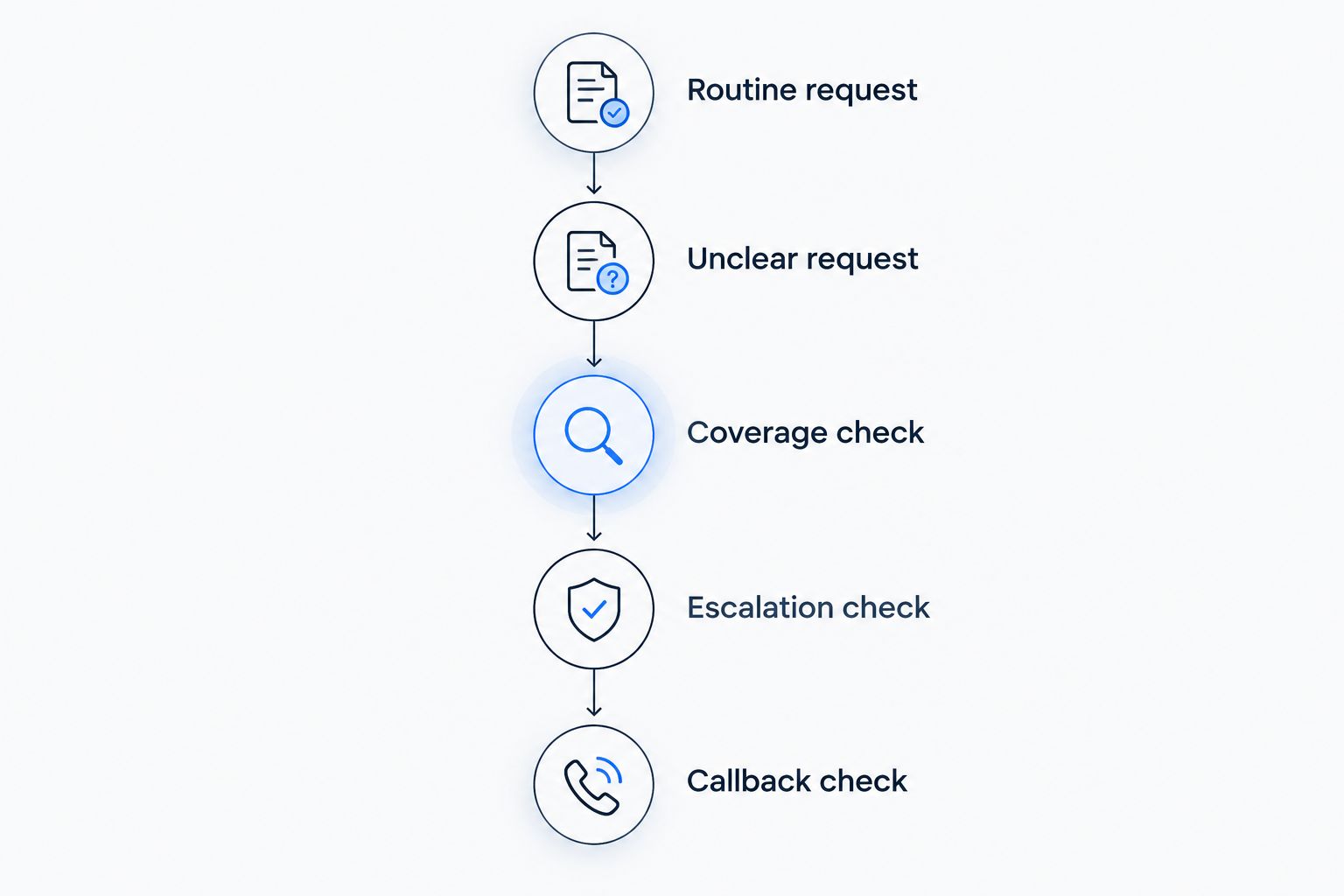
After each call, inspect the message your team receives. Check whether it records the customer’s words, contact details, location, and promised next step accurately. Treat an invented appointment or diagnosis as a failed test.
Before the trial, give the provider 1 written intake brief with your services, exclusions, coverage rules, and contacts. Use 1 named owner for script updates. These are setup recommendations for your 2026 selection process, not guarantees of results.
How the options are ranked
This 2026 ranking matches service models to distinct jobs: website-connected intake, human conversation, crew handoffs, backup coverage, and callbacks. It does not rank unnamed providers by response speed or customer satisfaction.
The six criteria above supply the decision framework. Choose the model that owns your main problem, then require the individual provider to demonstrate the details. Do not buy a dispatch process for a voicemail problem—or a message inbox for a dispatch problem.
Which answering service should you choose?
Choose managed website and call intake when you need both systems handled together. That is the default recommendation for the reader replacing a weak website and an unfinished intake process at the same time.
If your website already works, choose by the phone task. Pick live reception for conversation, dispatch-focused answering for crew handoffs, or overflow answering to support your office. Keep voicemail-to-message intake for nonurgent callbacks with a clear owner.
For 2026, make one rule nonnegotiable: the service must explain what happens after it answers. A call is not handled until your team has an accurate message and an approved next action.
FAQ
What's the best answering service for electricians in 2026?
The best choice depends on the job you need covered: managed website intake, live conversation, dispatch, overflow, or callbacks. Choose the service model first, then test the provider against your intake and handoff rules.
Is automated answering better than a live receptionist?
Neither model is best for every electrical business. Choose live reception when human conversation is your priority, and evaluate automated answering against the same requirements for accurate intake and approved next actions.
Can an answering service book electrical appointments?
Appointment booking must be an explicitly agreed function, not an assumption. Define calendar access, job restrictions, and the difference between a requested appointment and a confirmed booking.
What should an electrician's answering service ask callers?
An electrician's answering service should collect the caller's name, callback number, job location, and description of the requested work. Follow-up questions should gather information without diagnosing the electrical problem.
How should an answering service handle urgent electrical calls?
An answering service should follow your approved safety and escalation policy for urgent electrical calls. Do not ask intake staff or software to improvise electrical troubleshooting or promise an arrival without authorization.
Do I need full coverage or just overflow answering?
Choose overflow answering when your existing team remains the main call handler and needs backup. Choose broader coverage when you want the service to be the primary answering route, with its hours and responsibilities explicitly agreed.
How do I compare answering-service costs without guessing?
Request a written proposal for your exact coverage and workflow. Check the billing basis, included tasks, usage charges, setup requirements, and cancellation terms before comparing providers.
One last thing
Test a caller who asks for something you do not offer. That call reveals whether the service follows your boundaries or invents a helpful-sounding answer. An honest refusal with a clear next step is better than a promise your electrician has to undo.