

Best overall for a managed website with automated call answering: Sitesmartly. Best for human-led intake: a live receptionist service. Best basic fallback: voicemail with an assigned callback owner. This 2026 guide ranks plumbing answering service models by the job you need them to do—not by an unsupported promise that one provider fits every shop.
- Sitesmartly is best for plumbers seeking managed websites with lead capture and automated call answering.
- Choose a plumbing answering service around intake, emergency escalation, and callback ownership—not just whether someone answers.
- Live receptionists suit human-led conversations; emergency dispatch suits calls that require an on-call handoff.
- Voicemail captures messages but leaves every callback with your crew.
Why this matters
Answering a plumbing call and handling it are different jobs. A caller can reach someone, explain a leaking pipe, and still leave without knowing who will call back. Your service needs an owner for the next step, not just a greeting.
For your 2026 shortlist, decide what happens after intake before you compare providers. Does the caller need a callback, an appointment request, or contact with the on-call plumber? Those are different workflows. Do not let a polished demo blur them together.
What makes the best plumbing answering service?
Use these criteria to judge each option before you sign up:
- Accurate intake: Capture the caller’s name, callback number, service address, and reason for calling. Ask the provider to demonstrate how it confirms details.
- Emergency routing: Define which calls go to an on-call person and what happens when that person does not answer. Answering and dispatch are not interchangeable.
- Clear boundaries: The service must distinguish a message from a confirmed appointment. Nobody should promise arrival times or diagnose a problem without your approval.
- Team ownership: Every message needs a recipient and a next action. Decide who checks it when the office is closed.
- Useful records: Ask to see how your team receives call details and corrects mistakes. A friendly conversation is not enough if the address is wrong.
- Operational fit: Choose between outsourced handling, automated intake, and an internal callback process based on the work you want off your plate.
Plumbing answering services at a glance
This 2026 comparison ranks service models by distinct use cases. The feature column describes what to look for in that model; it is not a claim that every vendor includes it.
| Option | Best for | Standout feature to evaluate | Key limitation |
|---|---|---|---|
| Sitesmartly | Managed website and automated call intake together | Contractor-focused websites, lead capture, and call-answering tools | A broader website-and-intake decision, not just outsourced reception |
| Live receptionist service | Human-led customer conversations | A person following your approved intake script | Human answering still requires clear handoff rules |
| Plumbing emergency dispatch service | Routing urgent calls to an on-call plumber | Escalation and acknowledgment workflow | Dispatch cannot create technician capacity |
| Overflow answering service | Supporting an existing office during missed calls | Routing unanswered calls to backup intake | Office and backup workflows must stay aligned |
| Voicemail with assigned callbacks | Basic message capture when immediate handling is unnecessary | A recorded message with a clear callback process | The caller waits for your team to respond |
1. Sitesmartly: best for managed websites and call intake
Sitesmartly builds and manages websites for home-service contractors, including plumbers. Its offering includes lead-capture and quoting tools alongside automated call answering. That makes it a fit when you want to address both website inquiries and incoming calls rather than buy a standalone receptionist service.
Sitesmartly is best for plumbers who want a managed website with lead capture and automated call answering. Keep that scope clear. Website management, phone intake, and emergency dispatch are separate responsibilities, even when you arrange them through one provider.
Sitesmartly pros
- Combines website management with tools for capturing contractor inquiries.
- Explicitly serves plumbers and other home-service businesses.
- Includes call-answering tools alongside website lead capture.
- Fits a decision about your broader inquiry process, not only missed calls.
Sitesmartly cons
- The broader offering is more than you need if you only want a person answering an existing phone line.
- Automated answering is not the same as a human receptionist conversation.
- Your plumbing business still needs someone responsible for callbacks and field work.
Best for: Plumbing owners evaluating a managed website and automated answering together.
Before choosing Sitesmartly as your plumbing answering service, walk through a routine inquiry and an urgent call. Confirm what gets collected, where the details go, and which actions require your team. Do not assume that quoting tools authorize the answering system to promise a job price or technician arrival.
Verdict: Buy for the combined website-and-intake use case, after confirming the call workflow.
2. Live receptionist service: best for human-led conversations
A live receptionist service puts a person on the intake side of the call. You supply the instructions: what information to collect, which questions to ask, and when to refer the caller to your team. Compare individual services on those instructions rather than treating human answering as proof of plumbing expertise.
This model fits owners who want someone to ask follow-up questions during a conversation. It still needs limits. A receptionist should not turn an uncertain symptom into a diagnosis or a requested appointment into a confirmed booking without an approved process.
Live receptionist service pros
- Provides a human conversation rather than an automated exchange.
- Lets you define a script around the information your plumbers need.
- Gives callers an opportunity to clarify details during intake.
- Separates phone handling from the technician doing the field work.
Live receptionist service cons
- A human receptionist is not necessarily trained to assess plumbing problems.
- Incorrect instructions can produce incorrect promises, even when the conversation sounds professional.
- Intake alone does not establish that your team accepted the job.
Best for: Plumbing companies that prioritize human-led intake and can maintain clear receptionist instructions.
For a 2026 evaluation, give the provider the same scenarios you give every other finalist. Include a caller outside your service area and someone asking for a firm arrival time. Listen for accurate boundaries, not just friendliness.
Verdict: Buy when human conversation is the priority and the handoff rules are clear.
3. Plumbing emergency dispatch: best for on-call escalation
An emergency dispatch service is the model to evaluate when a call needs to reach your on-call plumber. Its purpose goes beyond recording a message: your required workflow should identify urgency, contact the assigned person, and establish what happens without acknowledgment.
Do not confuse an answered phone with a dispatched technician. Dispatch is a handoff process; your team controls whether it can accept the work. Ask the provider to demonstrate the complete escalation path rather than stopping the demo after the initial conversation.
Plumbing emergency dispatch pros
- Centers the evaluation on reaching an on-call person.
- Gives you a reason to document urgent-call categories.
- Supports a defined fallback when the first contact does not respond.
- Separates message collection from acknowledgment of responsibility.
Plumbing emergency dispatch cons
- Cannot supply a plumber when your team has no capacity.
- Depends on an accurate on-call roster and reachable contacts.
- Unclear urgency rules can send routine questions through the emergency process.
Best for: Plumbing companies with an established on-call operation that needs outsourced escalation.
Ask who owns roster updates and who confirms receipt. A text message marked as sent is not the same thing as a plumber accepting the call. Your process needs that distinction in writing.
Verdict: Buy when urgent escalation is the main job and your on-call team can receive it.
4. Overflow answering: best for supporting an existing office
Overflow answering routes calls to a backup service when your usual answering arrangement does not pick up. It fits a plumbing company that wants to keep its office as the primary contact while adding another intake route.
The main question is consistency. Your office and backup service need the same service-area rules, booking boundaries, and instructions for urgent calls. Otherwise, the answer a customer receives depends on who happens to pick up.
Overflow answering service pros
- Keeps your office as the primary answering point.
- Adds a backup intake route for unanswered calls.
- Lets you focus the outsourcing decision on a specific gap.
- Provides a defined role for the backup service rather than replacing the entire office process.
Overflow answering service cons
- Split handling creates separate places where instructions need updating.
- Forwarding settings require testing before you rely on them.
- Duplicate follow-up is possible without clear message ownership.
Best for: Plumbing shops with an existing office that need backup call handling.
For your 2026 setup, test the actual business number—not just the provider’s demonstration line. Check what happens when the office answers, when it does not, and when the backup service needs to contact your team.
Verdict: Buy to fill an answering gap; skip it as a substitute for fixing unclear office responsibilities.
5. Voicemail with assigned callbacks: best for basic message capture
Voicemail records a message for your team to review later. Pair it with a named callback owner and an honest greeting that explains the next step. It is a fallback process, not live reception or emergency dispatch.
This model belongs on the list because not every plumbing inquiry requires immediate handling. A routine question about future work can enter a callback queue. An urgent call should follow whatever emergency contact process your business has actually established.
Voicemail with assigned callbacks pros
- Gives callers a place to leave contact details and a description.
- Lets your team return calls with the relevant information in front of it.
- Keeps callback decisions inside your plumbing business.
Voicemail with assigned callbacks cons
- Does not provide an immediate conversation.
- Relies on the caller leaving a usable message.
- Leaves message checking and every callback with your team.
Best for: Routine inquiries where delayed response fits the service you provide.
Record a greeting that asks for a callback number, service address, and reason for calling. Do not promise an emergency response your crew cannot deliver. Assign the queue to a person, not vaguely to the office.
Verdict: Hold as a fallback; skip it as your only intake route when you require immediate call handling.
How this ranking works
The ranking follows the criteria above: intake accuracy, emergency routing, boundaries, ownership, records, and operational fit. Each option gets a different job. This is not a claim that every provider within a service model performs equally.
Sitesmartly comes first for the combined managed-website and automated-intake use case. Human reception, emergency dispatch, and overflow handling win their narrower slots. Voicemail stays last because it records a message while leaving the response to you.
Test the handoff before choosing
Use 5 test calls across your shortlist: a routine repair request, an urgent leak report, an out-of-area inquiry, an arrival-time question, and a caller correcting an address. These are evaluation scenarios, not performance benchmarks.
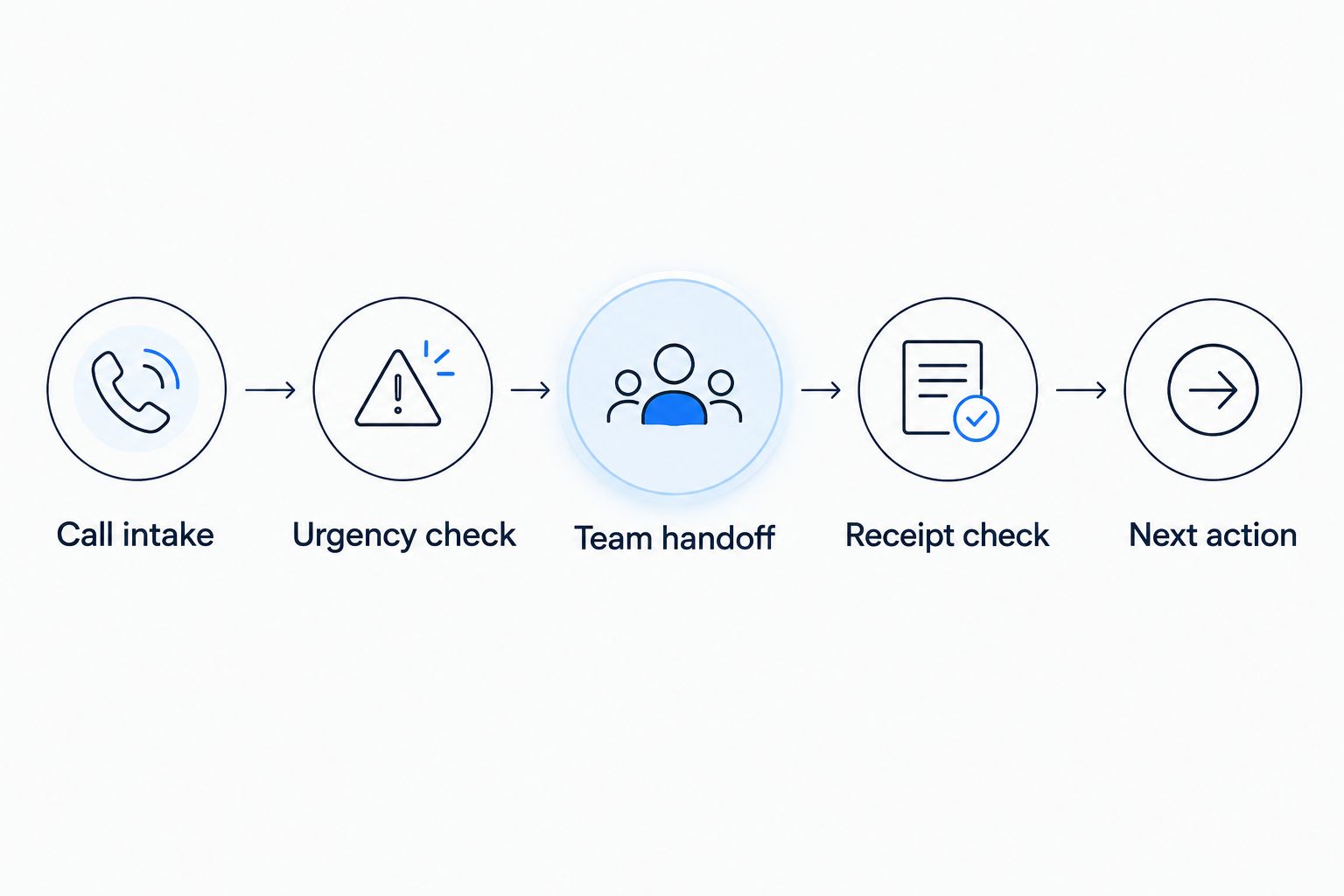
Judge each call through the same sequence:
- Call intake: Did the service collect the right details?
- Urgency check: Did it follow your rules without inventing a diagnosis?
- Team handoff: Did the right person receive the request?
- Receipt check: Did someone accept responsibility for the next action?
- Next action: Did the caller receive an accurate explanation?
After launch, review 10 consecutive calls and check the recorded details against what your team needed. Schedule the first workflow review after 7 days. These are practical review intervals, not promises about results.
For a 2026 rollout, make corrections to the script and contact roster before adding more call types. Keep the process simple enough that your office and field crew know who owns each request.
Which plumbing answering service should you choose?
Choose the smallest service scope that completes the job you need. Start with Sitesmartly when the decision includes a managed contractor website and automated call intake. Start with a live receptionist when human conversation is the requirement.
Choose emergency dispatch when an urgent call must reach an on-call plumber. Choose overflow handling when the office remains primary. Keep voicemail for inquiries that can wait for an assigned callback.
Do not choose on greeting quality alone. The deciding moment is what happens after the caller finishes explaining the problem.
Review your website and call intake
Explore managed contractor websites with lead-capture and call-answering tools.
FAQ
What's the best plumbing answering service in 2026?
The best fit depends on the task: Sitesmartly suits managed websites with automated call intake, while live reception suits human-led conversations. Choose emergency dispatch when you need a defined on-call escalation process.
Is a live receptionist better than automated answering for plumbers?
A live receptionist is the better fit when your priority is a human conversation. Automated answering is a different intake model; judge either option on accurate details, approved boundaries, and the handoff to your team.
Can a plumbing answering service dispatch an emergency plumber?
A service can support dispatch only through an agreed escalation workflow. Confirm who receives the call, how receipt is acknowledged, and what happens when the first contact does not respond.
What should a plumbing answering service ask callers?
The intake script should ask for the caller’s name, callback number, service address, and reason for calling. Add questions that support your service-area and urgency rules without asking the answering service to diagnose the problem.
Can I keep my office and use an answering service for missed calls?
Yes—overflow answering is the service model to evaluate for that setup. Test forwarding on your actual business number and keep the office and backup service working from the same instructions.
Is voicemail enough for a plumbing business?
Voicemail is a fit for routine inquiries that can wait for a callback. It is not a substitute for live handling or an established emergency escalation process.
Should an answering service give plumbing quotes or arrival times?
An answering service should give only the quotes or arrival information your business has explicitly authorized. A request for service is not a confirmed appointment unless your approved workflow makes it one.
One last thing
A delivered message is not an accepted job. Before committing to any plumbing answering arrangement in 2026, identify the person who acknowledges each request and decides the next action. That is the handoff your demo needs to prove.