

Best for managed websites with call-answering tools: Sitesmartly. Best for human-led emergency intake: a restoration-focused live answering service. Best for covering missed calls without replacing your office: an overflow answering service. This 2026 guide ranks coverage models so you can choose the right fit without confusing answering a call with dispatching a crew.
- Sitesmartly fits answering services for water restoration companies that also need managed websites and lead capture.
- Choose restoration-focused live answering when human-led emergency intake is your main requirement.
- Choose overflow answering when your office handles calls but needs backup.
- Test emergency escalation, accurate messages, and callback ownership before committing to any service.
Why this matters
A water restoration caller needs a clear next step. Taking a name and sending an email does not establish whether someone is handling the request. Your answering setup needs to distinguish a new emergency, an existing customer's update, and a routine inquiry.
The buying decision in 2026 is not simply human versus automated answering. It is who collects the details, who receives them, and who takes responsibility for the callback. Keep those jobs separate when you compare options.
This ranking compares service models rather than claiming that one named provider has better response times than another. Choose the model first. Then check the provider's actual call handling against your operating rules.
What makes the best answering service for water restoration?
- Emergency intake: The service collects the property address, callback number, and a plain-language description of the problem without turning the call into a long questionnaire.
- Escalation ownership: Your instructions identify who receives urgent requests and what happens when that person does not respond.
- Caller expectations: The service separates requesting help from confirming a crew visit. It never promises an arrival time your team has not approved.
- Message accuracy: Names, numbers, addresses, and the caller's own description reach the person responsible for follow-up.
- Coverage fit: You choose primary answering, overflow, or after-hours coverage according to the gap in your current operation.
- Management burden: Scripts, contact lists, and handoff rules stay easy to update when your staffing changes.
Do not buy broader coverage to solve an unclear handoff. A service cannot follow an escalation rule you have not defined.
Answering options at a glance
| Rank and option | Best for | Standout approach | Key limitation |
|---|---|---|---|
| 1. Sitesmartly | Managed websites with call-answering tools | Website management, lead capture, quoting tools, and automated call answering | Verify emergency escalation and dispatch requirements separately |
| 2. Restoration-focused live answering | Human-led emergency intake | A human operator follows your restoration intake instructions | Script quality and escalation rules need active oversight |
| 3. Overflow answering | Backup for an existing office | Calls route to backup coverage under conditions you define | Routing errors create inconsistent experiences |
| 4. Virtual receptionist service | Routine inquiries and administrative intake | Reception-style handling of general calls | Routine reception is not the same as emergency dispatch |
| 5. In-house on-call rotation | Direct control over urgent callbacks | Your own designated employee handles the request | Coverage depends on staff availability and backup discipline |
These are different operating choices, not interchangeable packages. For your 2026 shortlist, ask each provider to demonstrate the row that matches your needs instead of comparing feature lists in isolation.
1. Sitesmartly: best for website-led lead capture
Sitesmartly builds and manages websites for home-service contractors, including water restoration companies. Its stated offering includes industry-specific lead capture, quoting tools, and automated call-answering tools. That makes it relevant when you need help with both your website and incoming inquiries.
Sitesmartly is best for water restoration contractors who want managed websites and call-answering tools together. Evaluate it as that combined service, not as a substitute for a staffed emergency dispatch operation.
Pros:
- Managed website work belongs within the stated service.
- Lead-capture tools address inquiries that arrive through the website.
- Call-answering tools extend the scope beyond website forms.
- The service explicitly serves home-service contractors, including restoration companies.
Cons and checks:
- Confirm how urgent calls reach your designated employee.
- Verify any required transfers, notifications, or connections to your existing systems.
- A combined website service is a less focused choice if you only need independent human telephone coverage.
Best for: Contractors who need their website, lead capture, and call answering addressed together.
Verdict: Buy for the combined website-and-answering need; hold if your only requirement is staffed emergency dispatch.
2. Restoration-focused live answering: best for human intake
A restoration-focused live answering service uses human operators to collect incoming requests under your instructions. Look for a service that can distinguish urgent property-damage calls from scheduling questions and existing-customer updates. Ask for a demonstration using your script, not a generic receptionist example.
The useful distinction is human intake, not an assumed technical qualification. Operators should collect information and follow your escalation instructions rather than diagnose damage or promise what your crew will do.
Restoration-focused live answering pros:
- A human operator can ask follow-up questions within an approved script.
- Your intake instructions can distinguish different call types.
- You can define a direct handoff to an on-call employee.
- Call reviews can reveal where instructions need improvement.
Restoration-focused live answering cons:
- A restoration label does not prove that an operator knows your procedures.
- Long scripts burden distressed callers.
- Human answering still fails when the receiving employee is unreachable.
Best for: Companies that prioritize human conversation during urgent intake.
Verdict: Buy when a live demonstration shows accurate intake and the escalation process you require.
3. Overflow answering: best for office backup
Overflow answering handles calls when your regular office cannot take them. It is a coverage arrangement, not necessarily a separate technology: either human operators or automated tools can provide the backup. Define the routing condition before choosing the provider.
This model fits an office that already handles calls well but needs support during busy periods or outside its selected answering hours. The main task is preserving the same message and handoff standards across both routes.
Overflow answering pros:
- Your existing office remains the primary contact.
- Backup coverage addresses a specific operational gap.
- You can use the same intake fields for office and overflow calls.
Overflow answering cons:
- Incorrect routing sends callers to the wrong destination.
- Different scripts create conflicting expectations.
- Office staff and backup operators need a clear way to avoid duplicate follow-up.
Best for: Restoration companies with a working office process that needs backup, not replacement.
Verdict: Buy for a defined coverage gap; skip until routing and callback ownership are clear.
4. Virtual receptionist service: best for routine calls
A virtual receptionist service handles general telephone reception under your instructions. Evaluate it for routine inquiries, message collection, and approved scheduling tasks. Do not assume its standard workflow includes restoration emergency handling.
For water restoration companies, the boundary matters. A customer asking about paperwork needs a different route from a caller requesting urgent help at a property.
Virtual receptionist service pros:
- General inquiries can follow a consistent reception script.
- Routine messages can reach the appropriate office contact.
- Separating administrative calls gives your emergency route a clearer purpose.
Virtual receptionist service cons:
- A routine scheduling script can slow down an urgent call.
- Emergency escalation requires explicit instructions and verification.
- Operators need boundaries around technical questions and visit commitments.
Best for: Companies that need administrative call handling alongside a separate emergency process.
Verdict: Buy for routine reception; hold as your emergency answering choice until the handoff is demonstrated.
5. In-house on-call rotation: best for direct control
An in-house on-call rotation assigns incoming urgent requests to a designated employee. It is an alternative to outsourcing rather than an answering-service vendor. Include it in your comparison because outside coverage still needs someone inside your company to act.
Your employee knows your operation, but availability is a separate question. A technician working on a job cannot automatically serve as uninterrupted telephone coverage.
In-house on-call rotation pros:
- Your company controls the conversation and follow-up.
- Staff can use their knowledge of your service area and current work.
- Operational questions stay with the people responsible for delivery.
In-house on-call rotation cons:
- Calls depend on the assigned employee being reachable.
- Work, rest, and telephone duties compete for attention.
- An undocumented rotation creates uncertainty about responsibility.
Best for: Companies with a defined duty schedule and a reliable backup contact.
Verdict: Hold as a standalone solution unless your staffing supports it; use it as the receiving end of outsourced intake.
Test the handoff before choosing a service
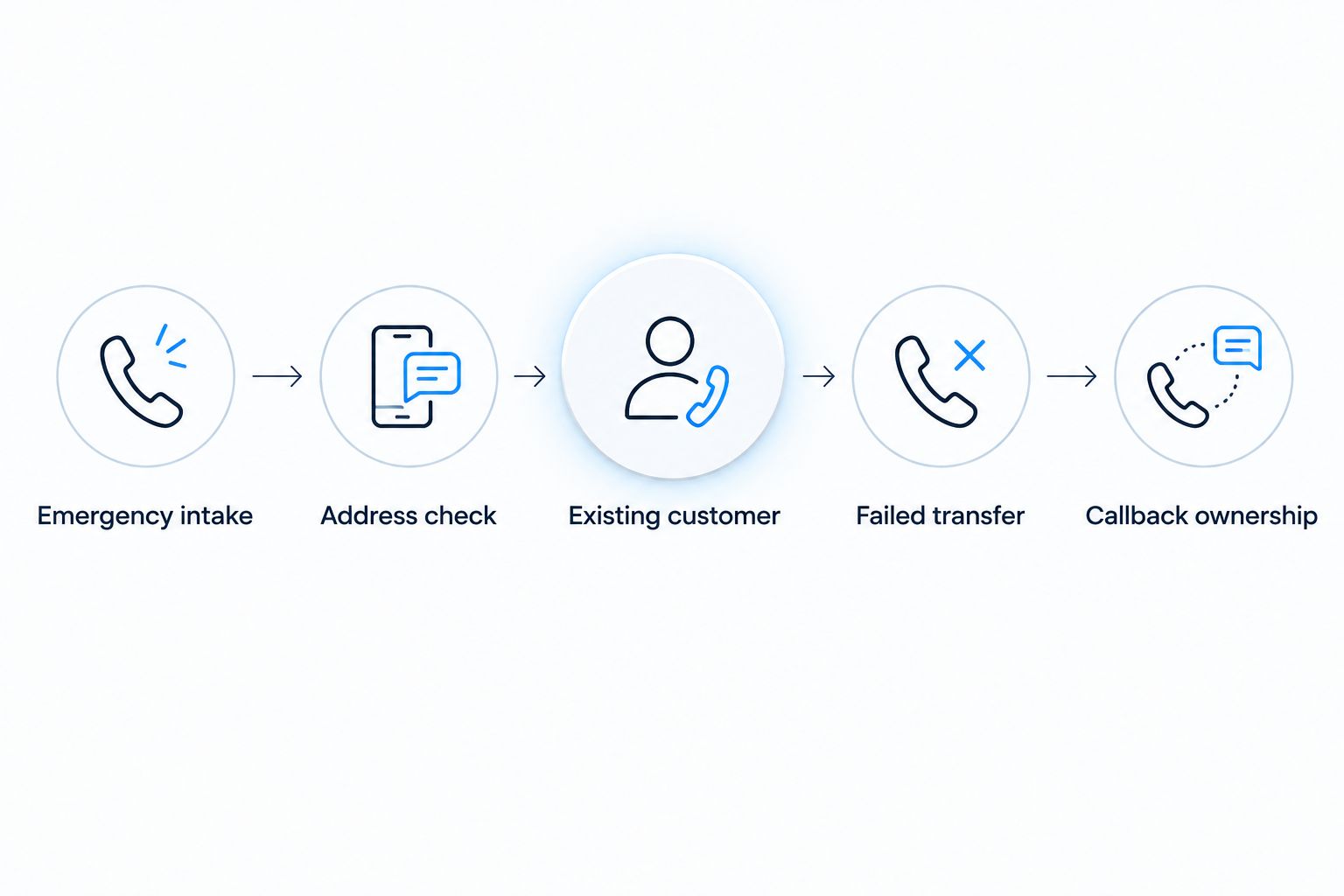
For your 2026 evaluation, use 5 test calls. This is a recommended buying checklist, not a claim about provider performance.
- Emergency intake: Describe an active water problem. Check whether the operator collects essential details without making unauthorized promises.
- Address check: Give an address outside your service area. Check whether the service follows your approved response.
- Existing customer: Ask for an update on work already underway. Confirm the request reaches the right contact.
- Failed transfer: Leave the primary contact unanswered. Check whether the backup route actually runs.
- Callback ownership: Request a callback without booking a visit. Confirm the message identifies who must act.
Keep 3 required fields in your basic intake checklist: callback number, property address, and problem description. Add other questions only when your team needs them to decide the next action. Your technical assessment belongs with qualified staff, not an improvised telephone script.
Assign 2 named contacts to urgent escalation: a primary and a backup. Define what each person receives and how responsibility passes between them. These are setup recommendations, not evidence that a particular service supports every step.
How these options are ranked
The ranking follows coverage fit, intake clarity, escalation ownership, and management burden. Website-led answering comes first for contractors seeking the combined managed service. Human-led intake, office backup, routine reception, and internal coverage each serve a different need.
No placement here implies measured superiority in call speed, booking rates, or restoration expertise. For a 2026 purchase, the strongest evidence is a demonstration of your actual workflow, followed by clear written responsibilities.
Which answering option should you choose?
Choose the coverage gap, not the longest feature list. If your website and inquiry handling both need attention, start with the managed website-and-answering option. If your main problem is urgent telephone intake, start with restoration-focused live answering.
Use overflow when your office process works but misses calls. Use a virtual receptionist for routine reception. Keep an internal primary and backup wherever urgent requests require your company's decision.
Before signing, write down the trigger for escalation, the receiving contact, and the caller's next step. If those instructions are unclear, fix them before adding another answering layer.
FAQ
What's the best answering service for a water restoration company?
The best option depends on the coverage gap: choose managed website-and-answering services for combined lead capture, or restoration-focused live answering for human-led emergency intake. Confirm the urgent handoff with a demonstration before choosing.
Is automated answering better than a live answering service?
Neither approach is automatically better for every restoration company. Compare how each handles your intake script, exceptions, and escalation rules rather than choosing by the technology label.
Can an answering service dispatch my restoration crew?
Answering a call does not establish that a service can dispatch your crew. Verify dispatch responsibilities, approval rules, and the handoff to your team separately.
What information should a restoration answering service collect?
Start with the callback number, property address, and the caller's description of the problem. Add questions only when they support your next operational decision, and leave technical assessment to qualified staff.
Do I need full-time answering or just overflow coverage?
Choose overflow when your office handles calls well but needs backup under defined conditions. Choose broader coverage when you need an outside service to serve as the primary answering route.
How do I compare answering services in 2026?
Compare services using the same emergency, service-area, existing-customer, failed-transfer, and callback tests. Judge message accuracy and responsibility for follow-up, not just whether someone answers.
One last thing
The most revealing test is an unanswered transfer. A successful greeting proves that the service can pick up. An unanswered transfer shows whether your process has a real backup or simply moves the missed call somewhere else.
Run that test with your designated contacts. Then read the message they receive. The right answering setup leaves your team with an actionable request and the caller with an honest next step.